
Preceptors are vital to the success of our goal at the Harrison College of Pharamcy to train and educate Practice Ready Pharmacists. With more than 500 preceptors spread across the region, HCOP benefits from a diverse representation of experiences, practice sites, backgrounds, and perspectives among our preceptors. Click below to learn more about these valuable members of our Experential Education team.
To learn more about becoming a preceptor, visit our Becoming a Preceptor page.
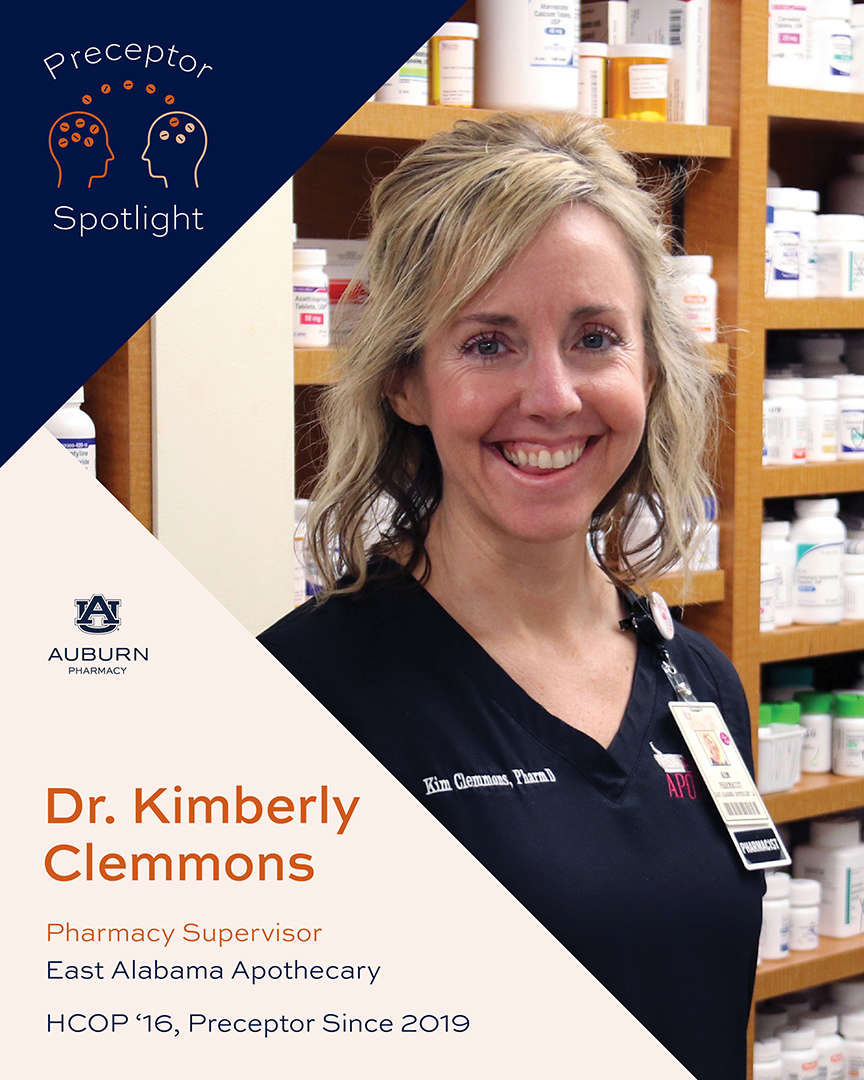
Why did you choose to become a preceptor?
When I was a student, I knew community/retail pharmacy would be my future. I had great preceptors at the two rotations centered around retail pharmacy when I was a P4. When I began working at East Alabama Apothecary, I realized that our pharmacies offered something unique at each location. I knew students would enjoy seeing the different types of retail pharmacy and having a change of pace each week. Students have the chance to be exposed to medications that they may never see again. Some specialty medications are nearly $30,000. Our Meds2Beds Program takes students all over the hospital. Observations in the Infusion Center, visits to patient homes and other various experiences are also possible. It can be a fun 5 weeks for students that come with an open mind and an eagerness to learn.
What has been the most rewarding aspect of precepting student pharmacists?
The most rewarding aspect of precepting is the one-on-one time I can spend discussing patient situations unique to hospital discharges. This could include uncommon medications or programs available for patients needing help with adherence or cost of prescriptions. I also enjoy talking with the student about various 'hiccups' encountered with a prescription. This could include navigating DUR rejections, fixing insurance claim rejections, and medication therapy management.
The Apothecary’s rotation also includes a “Map to the Apothecaries” experience. Employees including directors, pharmacists, interns and technicians have offered to share their knowledge about specific duties that relate to their job description. Our HCOP students are given the map and told that it is their responsibility to complete it. Apothecary employees are expecting the student to approach them and ask questions. This gives the student some autonomy over their rotation. I really enjoy seeing students go out of their comfort zone to dig in, ask questions and complete this “Map to the Apothecaries”.
What is one key to success for rotations that you would like to share with current student pharmacists?
The primary key to a successful rotation is to “be teachable”. You may have several years of experience in retail pharmacy however, I can assure you that you will see new aspects of the retail world that you haven’t seen before. Keep an open mind.
What was your favorite course in pharmacy school? Why was it your favorite?
Integrated Pharmacology (previous curriculum) was my favorite pharmacy school course. Our class was divided into teams and assigned a facilitator. Each team opened a case and had round table discussions of the disease state(s) and medications. The case was a real world scenario of a patient experience. We were able to put everything learned over the previous two years together and apply it to the case. Seeing the big picture and working through each case as a team was rewarding.
What is a fun fact about you or your practice site?
A fun fact about me is at I enjoy working out and love running (for fun). I was a personal trainer prior to going back to school for pharmacy and began running with my dad many many years ago in high school. Also, I went to pharmacy school when I was in my 30’s and had two little ones - 18 months and 5 years old. So, I had a very different perspective and experience throughout school.
A fun fact about East Alabama Apothecary is that we offer many unique programs across 4 pharmacies. Our rotation is much different than what you could see in most community rotations. Some programs you could expereience are Meds 2 Beds at EAMC, Oncolytic medications and infusions at Spencer Cancer Center, Specialty medications (that are not often seen in community pharmacies) and our Pharmacotherapy Clinic. It's really fun for students to see so much in their short time with us.